Wednesday, July 29, 2015

Swami Vivekananda: Hymn of Samadhi

নাহি সূর্য নাহি জ্যোতিঃ নাহি শশাঙ্ক সুন্দর।
ভাসে ব্যোমে ছায়া-সম ছবি বিশ্ব-চরাচর॥

অস্ফুট মন আকাশে, জগত সংসার ভাসে,
ওঠে ভাসে ডুবে পুনঃ অহং-স্রোতে নিরন্তর॥

ধীরে ধীরে ছায়া-দল, মহালয়ে প্রবেশিল,
বহে মাত্র ‘আমি আমি’ — এই ধারা অনুক্ষণ॥

সে ধারাও বদ্ধ হল, শূন্যে শূন্য মিলাইল,
‘অবাঙমনসোগোচরম্’, বোঝে — প্রাণ বোঝে যার॥


Lo!  Neither the Sun nor the Moon, all light deluded, 
In the great voids of creation, floats shadow-like the image of universe.

In the voids of mind involute, floats the fleeting universe, 
Rises-floats, sinks again, incessantly in the currents of one's stream of ego.

Gradually the multitude of shadows, entering the primal womb, 
Subsequently ensued the stream of 'Ami', flowing ceaselessly.

Lo! even that stream of 'Ami' flows no more, void merges into void
Beyond sensory faculties, only he understands whose 'atman' (soul) realizes.

Friday, July 24, 2015

Hindu Temple and The Golden Ratio


A Hindu temple aligned to the Vedic architecture (Brihat Samhita) has a deep yogic relation to the human body and the spiritual chakras therein. Refer the image for more
 - The feet represent the spire. 

 - The hands represent the walkway/exterior porch around the temple. 
 - The main hall represents the abdomen.
 - The entrance porch represents the heart.
 - The sanctum (garbha-griha) represents the head where the deity is consecrated

There is proportionality between the size of the deity in the sanctum and the sizes of the temple. As per the Samhita
 - The height of the temple should be double its width. 
 - The height of foundation above ground should be equal to a third of temple height. 
 - The sanctum should be half the width of the temple 
These guidelines translate into various interpretations of the Golden Ratio of 1.618 (Refer diagram, point C divides the line in such a way that the ratio of AC to CB is equal to the ratio of AB to AC)

Wednesday, July 15, 2015

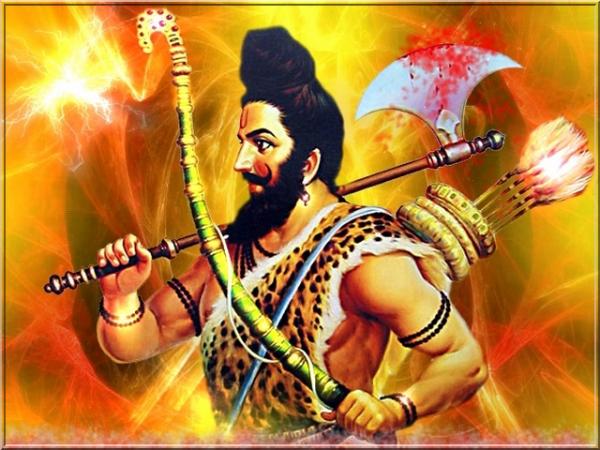
Parashuram: The Warrior Rishi

Jamadagni, was a direct descendant of Brahma. But Before the birth of their fifth son, Jamadagni with his wife Renuka, meditated for divine boons. With the blessing of Lord Shiva, Vishnu was born in his sixth Avatar, as the youngest son of Jamadagni-Renuka, Parashuram.

As he grew older, Parashuram left home to do devout austerities and pleased Lord Shiva. Shiva presented Parashuram with Divine weapons along with the indestructible axe, ‘Parashu’ and advised him to go and liberate the Mother Earth from ill-behaved extremists, demons and those blinded by pride.

One day, while Parashuram was away in the forest cutting wood, King Kartavirya came to the hermitage of Jamadagni. In honor of the King, the Rishi served him a grand feast. Surprised by the grandeur, the King asked how the Rishi was able to serve up such magnificent food with limited resources. Jamadagni showed him the 'Kamadhenu' calf given by Indra. King Kartavirya wanted to take the calf. The Rishi refused and Kartavirya stole the sacred 'Kamadhenu'. On returning home, Parashuram was infuriated and traveled to the royal palace, he decimated the royal guards and killed King Kartavirya, thus retrieving the calf. Parashuram went on a pilgrimage of holy places for one year as penance of this act. Meanwhile, the sons of Kartavirya attacked the hermitage and murdered Jamadagni. When Parashuram returned home, he found his mother next to the body of his father, crying hysterically as she beat her chest twenty-one times in a row. Parashuram then vowed to rid the earth of the war-mongering Kshatriyas twenty-one times over, once for each time his mother beat her chest.

Parashuram among many heroic feats, once clipped the thousand arms of 'Sahastrarjun' (incarnation of Vishnu's Sudarshan Chakra') with his Parshu and killed him. Lord Indra pleased with this feat, gifted the Vijaya bow (of Lord Shiva) to Parashuram. Later, Parashuram had given this ‘Vijaya’ bow of Shiva to King Janaka, the father of Sita. As a test of worthiness, Sita's suitors at the 'Swayam-var' were asked to lift and string the mystic bow. None were successful until Rama, who in the process broke the bow into half.

Parashuram traveled to the Himalayas to pay respect to his teacher, Shiva. While travelling, his path was blocked by Lord Ganesha. Enraged, Parashuram threw his axe at the later. Ganesha, realizing the weapon to be that of Lord Shiva, paid its due respect and allowed it to sever his left tusk (thus named 'Ekadanta', meaning One Toothed). Parashuram on realizing the gravity of this event, sought forgiveness from Shiva-Parvati. Upon being forgiven, he gave this divine axe to Ganesha and blessed him.

Parashuram has the gift of immortality, he was witness to Vishnu's later avatars as Ram, Krishna and the rest that followed

Tuesday, July 14, 2015

Nandi: An Embodiment of Meditation

Nandi is a symbolism of eternal ‘bhakti’ and meditation on inaction (a.k.a waiting). In Hindu Mythology waiting is associated with patience, tolerance, receptivity and considered one of the greatest virtues. Spiritually, Nandi represents the Jiva-Atman (Soul) that is meditative on the Param-Atman (God)

Prayer is our conversation with God. However, meditation expresses our willing to listen to God. Later is the quality of Nandi, full of alertness, selflessly waiting to listen and abide by his master's instructions. Reason why Hindu Mythology claims that Nandi had received the boon from Lord Shiva that any devotee of Shiva, who say their prayers into the ears of Nandi, their prayers would definitely reach the Lord!

While writing this piece, I am reminded of the sonnet 'On His Blindness' by John Milton; the concluding line: 'They also serve who only stand and wait'

Monday, July 13, 2015

Surpanakha & The Battle of Lanka

Surpanakha (Sanskrit for sharp, long nails) was the sister of Ravana. Valmiki describes Surpanakha to be ugly, pot-bellied, cross-eyed, with brown hair and a grating voice. During a visit to the Forest of Panchavati she met exiled Ram. Smitten by his radiant looks, she proposed marriage to Ram. Ram rejected her offer as he was married to Sita. Rejected, Surpanakha then approached Lakshmana, who also rejected her he was married too. The humiliated Surpanakha attacked Sita, who was the reason behind Ram’s denial. Sita was defended by Lakshmana, who cut off Surpanakha’s nose.
Surpanakha first went to her brother Khara, who sent Rakshasa warriors to attack Ram, who were soon defeated. Surpanakha then went straight to Ravana's court and pleaded her brother to abduct and wed Sita by extolling her virtues and beauty. Ravana kidnapped Sita, thus triggering the Battle of Lanka.

Monday, June 29, 2015

The Vedas and its Origin

Rigveda
The Rigveda Samhita is the oldest Veda. It is a collection of 1,028 Sanskrit hymns and 10,600 verses. The hymns are dedicated to Rigvedic deities.  More than half the hymns are dedicated to Indra (250 hymns), Agni has 200 hymns, and Soma over 100 hymns.

Samaveda
The Samaveda Samhita consists of 1549 stanzas. The Samaveda Samhita comprises two major parts. The first part include four gāna (melody collections) and the second part composed of three ārcika (verse books). A melody in the gāna corresponds to a verse in the arcika.

Yajurveda
The Yajurveda Samhita consists of mantras. The early part of Yajurveda Samhita are in prose. The Yajur Veda has been the primary source of information about sacrifices during Vedic times and associated rituals. There are two major groups of texts in this Veda: the "Black" (Krishna) un-arranged collection and the "White" (Shukla) well-arranged section.

Atharvaveda
The Artharvaveda Samhita was composed by Atharvan and Angirasa poets. It has 760 hymns. Most of the verses are metrical, but some sections are in prose. The Atharvaveda is a comparatively late extension of the "Three Vedas". The Atharva Veda has been the primary source for information about Vedic culture, the customs and beliefs, the aspirations and frustrations of everyday Vedic life, as well as those associated with kings and governance. 

What's the Origin of the Vedas and its inception?
Lord Brahma after a day full of creation, was tired and fell asleep. In his sleep, he was reciting the knowledge in the four Vedas from his four heads. Asura Madhu-Kaitabha started absorbing the knowledge in the Vedas. He then hid deep inside the ocean crater. Lord Vishnu knew this and was worried, if the Vedas were to be hid by the asura, the knowledge could not be passed on for the betterment of creation in the subsequent Yugas. 
As Preserver, Lord took his Matsya avatar. A god-loving, honest and just king, King Manu, as part of his daily routine went to the river for his prayers at dawn. He took some water in his cratered palms to offer obeisance to Lord Vishnu. Right then, he heard a voice ‘O great king! Please do not put me back in the river. The bigger fishes would eat me!’ Manu looked closely to find a tiny fish floating in the water cupped by his palms. Kind King Manu put the fish in his ‘Kamandala’ (small jug carried by sages) and went about his daily duties. He woke up next morning to find a big fish staring at him from the top of the 'Kamandala'. The tiny fish had grown bigger and the ‘Kamandala’ was now too small for it.
Manu transferred the fish to a bigger container, but it kept growing bigger every time he put it into a bigger vessel. Manu then took the fish to the river from where he rescued it. However, like before it got bigger, taking up the width of the entire river. Finally Manu guided the fish to the ocean, where it grew into a gigantic fish. By now Manu had realized that this fish was no ordinary one and requested it to reveal its true identity. Upon Manu's request, this gigantic fish transformed into Lord Vishnu. In his Godly form, Vishnu told Manu that in the next seven days there would be huge deluge. The Lord instructed Manu to build a huge boat, collect seeds from all plants, gather male and female pairs of all animal species, and shelter the seven sages along with their families in this boat. Vishnu promised to return with Vasuki (The Snake God) on the seventh day, saying this Lord Vishnu transformed back into the massive fish and left in search of the demon Madhu-Kaitabha whom he soon located. After a brief futile struggle, Madhu-Kaitabha was fatally injured by the giant fish. However only Three Vedas could be rescued. Asura, in its dying breath sought forgiveness from the Lord and asked for a boon that would rid him of sins. Merciful Vishnu, granted him the boon to be reborn as a learned sages and compose the 'last Veda' that he had failed to give up at this time.
On the seventh day, after torrential rains and huge floods, the giant fish came to rescue Manu and all of creation. Vasuki was tied to the huge boat on one end, the other end was fastened to the horn atop the giant fish's head. Then the fish guided the boat over the waters to the shores atop Mount Himavan. The rescued flora and fauna started life afresh with the gift of the Three Vedas! Atharva Veda was to be introduced later by sage Atharvan and Angirasa (rebirth of the Madhu-Kaitabha as sages)

Wednesday, June 24, 2015

Swami Vivekananda's Chicago Speech

Sisters and Brothers of America, 
It fills my heart with joy unspeakable to rise in response to the warm and cordial welcome which you have given us. I thank you in the name of the most ancient order of monks in the world; I thank you in the name of the mother of religions, and I thank you in the name of millions and millions of Hindu people of all classes and sects.
My thanks, also, to some of the speakers on this platform who, referring to the delegates from the Orient, have told you that these men from far-off nations may well claim the honor of bearing to different lands the idea of toleration. I am proud to belong to a religion which has taught the world both tolerance and universal acceptance. We believe not only in universal toleration, but we accept all religions as true. I am proud to belong to a nation which has sheltered the persecuted and the refugees of all religions and all nations of the earth. I am proud to tell you that we have gathered in our bosom the purest remnant of the Israelites, who came to Southern India and took refuge with us in the very year in which their holy temple was shattered to pieces by Roman tyranny. I am proud to belong to the religion which has sheltered and is still fostering the remnant of the grand Zoroastrian nation. I will quote to you, brethren, a few lines from a hymn which I remember to have repeated from my earliest boyhood, which is every day repeated by millions of human beings: "As the different streams having their sources in different paths which men take through different tendencies, various though they appear, crooked or straight, all lead to Thee."
The present convention, which is one of the most august assemblies ever held, is in itself a vindication, a declaration to the world of the wonderful doctrine preached in the Gita: "Whosoever comes to Me, through whatsoever form, I reach him; all men are struggling through paths which in the end lead to me." Sectarianism, bigotry, and its horrible descendant, fanaticism, have long possessed this beautiful earth. They have filled the earth with violence, drenched it often and often with human blood, destroyed civilization and sent whole nations to despair. Had it not been for these horrible demons, human society would be far more advanced than it is now. But their time is come; and I fervently hope that the bell that tolled this morning in honor of this convention may be the death-knell of all fanaticism, of all persecutions with the sword or with the pen, and of all uncharitable feelings between persons wending their way to the same goal.

Monday, June 22, 2015

Brahma-Vishnu-Mahesh: The Holy Hindu Trinity

Every process is initiated on completion of its preceding process. The best way to carry out a set of activities for a given process, one needs to know the process preceding it. This establishes the cyclic infinitum of nature.
Brahma before creation needs to understand the universal spirit made available as a result of destruction, therefore he meditates on Shiva. Vishnu is the Preserver, to carry out his duties as the preserver he meditates on Brahma to understand the nuances of creation. Shiva as annihilator, meditates on \Vishnu to best understand what is under the spheres of preservation and what needs destruction before Brahma ushers in creation

Sheshnaga: The Serpent of Lord Vishnu

Sheshanaga (Sanskrit meaning is one of the primal Snakes). Per the Puranas, Shesha holds all the planets of the universe on its hoods while constantly singing the glories of the God Vishnu from all its mouths. When Adishesa uncoils, time moves forward and creation takes place and when he coils back, the universe ceases to exist.
Shesha is depicted as a thousand hooded snake that floats on 'KhirSagar', forming the bed on which Vishnu lies. Along with many 'Avatars' (incarnations) of Vishnu, Shesha is said to have descended to Earth in human avatars of Lakshman (brother of Rama), Balarama (brother of Krishna), Ramanuja, Patanjali, etc.
As per scriptures, Shesha was born to rishi Kashyap and his wife Kadru (daughters of prajapati Daksha). Kadru gave birth to a thousand snakes, of which Shesha was the eldest.
Krishna, was born to Devika and Vasudeva and had to be transported to Yashodha for immunity from cruel Kamsa. When Vasudeva was carrying baby Krishna across the river to Gokul, Sheshnaga rose from the river and shaded the baby Krishna from the torrential rain. At the time of Samudra-manthan, Sheshnaga become the rope with which the seas were churned.

Thursday, June 18, 2015

Vishnu: His Weapons and Forms

Shaantaa-kaaram bhujhga-shaynam padma-naabham suresham
Vishva-aadhaaram gagan-sadrisham meghvaran shubh-aangam
Laxmi-kaantam kamal-nayanam yogibhir-dhyan-gamyam
Vande vishnu bhav-bhay-haram sarva-lokeik-naathanam

He, who possesses a tranquil form, lies on the bed of snake, from whose naval has sprung the Lotus (of Brahma)
He, who is the Lord of all Gods, the support of the universe, complexion like dark clouds and possesses handsome features
He, who is the Lord of Laxmi, goddess of wealth has lotus-like eyes and revealed to yogis through meditation
Obeisance to that Vishnu who is the dispeller of the fear and Lord of all the worlds

The characteristic weapons of Vishnu in his four hands
1. Panchajanya Shankha (Conch-shell) that symbolizes purity of speech and 'Praan-Vayu' yoga of the Vishuddha Chakra
2. Sudarshan (Discus) symbolizes self-knowledge leading to emancipation of soul from Maya on activation of Ajna Chakra 
3. Kaumodaki Gada (Mace) symbolizes victory over the five vices lust, anger, greed, attachment and arrogance
4. Padma (Lotus) represents purity of actions and spirit of detachment that comes from activated Anahata Chakra

Four objects held by Four hands of Vishnu, leads to 24 forms (factorial 4 = 4X3X2X1 = 24). These 24 forms are 
1. Kesava, destroyer of demon Kesi (Padma left-upper hand, Shankha right-upper, Chakra right-lower and Gada left-lower)
2. Narayana, the universal shelter (Shankha, Chakra, Gada and Padma)
3. Madhava, Lord of knowledge (Gada, Chakra, Shankha and Padma)
4. Govinda, protector of cows and mother-Earth (Chakra, Gada, Padma and Shankha)
5. Madhusudana, the destroyer of the demon Madhu (Chakra, Gada, Shankha and Padma)
6. Trivikrama, the one who conquered the three planetary systems (Padma, Gada, Chakra and Shankha)
7. Padmanabhan, whose navel produced the universal Padma (Shankha, Padma, Chakra and Gada)
8. Shridhara, the possessor of fortune (Padma, Chakra, Shankha and Gada)
9. Hrishikesha, Lord of the senses (Shankha, Padma, Gada and Chakra)
10. Vamana, the dwarf incarnation (Shankha, Gada, Chakra and Padma)
11. Damodara, who is self-restrained (Padma, Chakra, Gada and Shankha)
12. Vishnu, the all-pervader (Gada, Padma, Shankha and Chakra)
13. Vasudeva, one who dwells within (Gada, Chakra, Padma and Shankha)
14. Pradyumna, who has the most wealth (Chakra, Shankha, Gada and Padma)
15. Aniruddha, who no one can oppose (Chakra, Shankha, Padma and Gada)
16. Purushottama, best of all men (Chakra, Padma, Shankha and Gada)
17. Adhoksaja, the expanse of the universe (Gada, Shankha, Padma and Chakra)
18. Narsimha, the half-man and half-lion form (Chakra, Padma, Gada and Shankha)
19. Achyuta, the inconceivable (Gada, Padma, Chakra and Shankha)
20. Krishna, the dark and all-attractive one (Shankha, Gada, Padma and Chakra)
21. Hari, He who removes obstacles or sorrow (Shankha, Chakra, Padma and Gada)
22. Janardana, He who gives rewards (Padma, Gada, Shankha and Chakra)
23. Upendra, the brother of Indra (Shankha, Padma, Gada and Chakra)
24. Sankarsana, who plows the mind-fields with 'bhakti' (Padma, Shankha, Gada and Chakra)